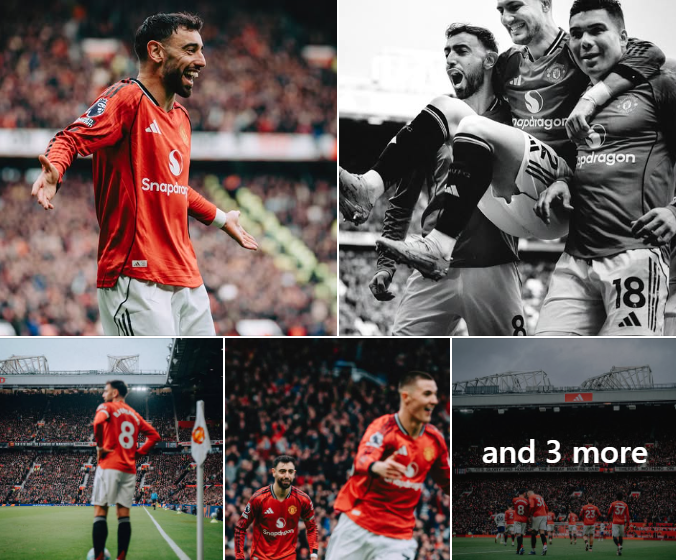
Manchester United were heading for another humiliation… But Carrick’s men tore Aston Villa apart in 45 devastating second-half minutes.
Manchester United 3–1 Aston Villa | Premier League | Old Trafford
There are nights at Old Trafford that linger. Nights that don’t dissolve into the grey routine of a long season but instead crystallise into something harder, something that future generations will pull from the archive and point to and say — that was the moment everything shifted.
March at Old Trafford has a particular texture to it. The sky above the stadium sits low and purple-dark by kick-off, the floodlights cutting upward through the cold air like searchlights sweeping for something lost. The pitch, still carrying the faint bruise-green of winter grass slowly returning to health, looks almost luminous under those lights. The Stretford End fills early on nights like this. The regulars, the ones who’ve been coming since before the Premier League existed as a brand, before the scarves were made in factories in East Asia and sold outside the ground for fifteen pounds apiece — they arrive early and they fill the lower tier first, and then the upper, and the hum begins before the teams have even left the tunnel.
This was one of those nights.
Manchester United hosting Aston Villa in a game that, on paper, carried the weight of a top-four conversation — third place against fifth, a gap of four points, Champions League qualification hovering over the fixture like a shared obsession neither side wished to acknowledge too loudly. But the story that was really being told, the one that the match programme hinted at and the pre-match punditry danced around, was the story of Michael Carrick.
PART ONE: THE CARRICK QUESTION
Michael Carrick had accepted the interim manager’s role under circumstances no one would have chosen. He stepped into a dressing room still warm from the departure of Erik ten Hag — a manager whose exit had been inevitable for months, a slow unravelling that had become painful to watch for everyone involved. Ten Hag had built something at United. Not the United of Ferguson’s era, not the red-machine that swallowed opponents whole and spat out trophies with annual regularity, but something nonetheless: a team with identity, with tactical shape, with the beginnings of belief.
And then it had come apart. Piece by piece, like a wall built too quickly in the wrong season, the mortar not yet dry when the first frost arrived.
Carrick had played under Ferguson. Had sat in the centre of United’s midfield during those last great years, reading the game the way a scholar reads a text — patiently, precisely, catching implications that others missed. He had managed before, briefly, doing enough at Middlesbrough to earn quiet respect within the football world. But this was different. This was Old Trafford. This was the job.
He had not asked for it to be called “permanent.” He had not lobbied for it. He had simply gone to work.
But after six weeks, after results had begun to stack in his favour, after United had climbed from seventh to third with a consistency that the club had not shown in over a year, the question would not go away: Was this still “interim”? Was it still “caretaker”? Or had the word changed without anyone noticing?
In the corridors of Carrington, in the quiet offices where club directors conducted their business, conversations were happening. The football world knew it. The journalists at the edge of those conversations could feel the temperature of them.
Tonight, against Villa, was not officially an audition. It was a Premier League fixture. Three points. No more, no less.
And yet everyone inside Old Trafford understood that it was exactly that.
PART TWO: FORTY-FIVE MINUTES OF UNCERTAINTY
The first half was difficult to watch if you were a United supporter.
Not catastrophically difficult. Not the shapeless, panicked football of certain dark periods in recent memory — the listless 4-0s, the humiliation at Brighton, the nights where you could feel the crowd withdrawing into itself as though physically retreating from the pitch. This was different. This was organised, considered, cagey. It was two teams that knew each other well enough to be cautious, circling one another like fighters who have studied each other’s tapes.
Aston Villa under Unai Emery had arrived in Manchester in a complicated state of mind. Three consecutive league defeats had stripped something from them — not quality, Emery’s sides were never short of quality — but confidence, the fragile compound that transforms ability into performance. They had lost to Arsenal, lost to Spurs, lost to Liverpool, and each defeat had carried a slightly different flavour of disappointment.
Against United, they came out compact. They sat in a mid-block and invited United to find a way through. Ollie Watkins, their primary threat, pressed from the front with tireless intelligence, cutting off passing lanes, forcing United’s centre-backs into lateral passes rather than progressive ones. Ezri Konsa at the back was commanding. Jacob Ramsey in the engine room worked without pause.
United responded with patience. Bruno Fernandes, wearing the armband with the casual authority of someone who has simply always worn it, dropped deeper than usual, collecting the ball from the defensive line and trying to find angles. Casemiro, now 33 and wearing the face of a man who has made peace with his career’s final chapter, was composed and tidy. He did not press. He did not try to be young. He moved the ball with the economy of someone who understands that football, at its best, is about managing time.
The problem was in the final third.
Matheus Cunha, arriving this January from Wolverhampton in a deal that had been long-anticipated, had been bright in flashes but was still finding his rhythm in a United shirt. The geometry of Carrick’s system suited him in principle — he liked playing off a striker rather than as the striker, liked cutting from wide channels into the inside-left position where he could arrive late at crosses or shoot across goal from the half-right angle. But Villa defended those channels well. Every time Cunha drifted, a Villa midfielder drifted with him.
Benjamin Sesko, the Slovenian centre-forward signed from RB Leipzig in the summer, had scored eight Premier League goals by this point in the season — a decent return for a player still adapting to the pace and physicality of English football, but not the haul that his athleticism and technical ability suggested was possible. Against Villa, he was isolated in the first half. He won a few headers. He held the ball up once, well, and laid it back to Fernandes who switched play and found nothing.
The half ended goalless.
In the dressing room beneath the stand, Carrick would have spoken quietly. He rarely shouted — former teammates described him as someone who delivered uncomfortable truths with the calm of a surgeon. He would have identified the adjustments. Slightly higher defensive line. Cunha to tuck in earlier when Villa transitioned. Fernandes to hold his position in the middle rather than dropping so deep.
Small changes. The kind that don’t make it into the tactical breakdown threads until after the fact, when they look obvious.
PART THREE: THE SECOND HALF DETONATES
The fiftieth minute.
United won a free kick just inside Villa’s half, twenty-two yards or so from the right touchline. Nothing spectacular, just a foul on Fernandes as he tried to skip past Ramsey. But from the restart, United worked it quickly — Fernandes playing a short pass to Casemiro on the edge of the box, Casemiro taking one touch to set himself, then striking low and hard to the goalkeeper’s left.
Emiliano Martínez got a hand to it.
The ball went in anyway.
The reaction of the Stretford End to Casemiro’s goal in the fiftieth minute was something that the people inside the stadium will carry for a long time.
It was not just celebration. It was vindication.
Casemiro had arrived from Real Madrid in the summer of 2022 under Ole Gunnar Solskjær’s successor, a signing of enormous ambition and equally enormous expense. He had been extraordinary in his first season. The kind of player who fills in the invisible architecture of a team — the passes that don’t make the highlights, the interceptions that prevent transitions, the sheer physical presence that allows others to express themselves without fear. He had looked, briefly, like the missing piece.
And then the decline had set in. Not of character — no one ever questioned Casemiro’s character — but of performance, the natural erosion that eventually comes for every footballer who carries his body through the accumulated collisions of a long career. He had been, at his worst points over the last eighteen months, a liability. A midfielder who could not press, could not recover, could not keep up with the game at the pace it demanded.
There had been stories in the summer about a potential departure. Saudi Arabia. MLS. A dignified exit.
He had stayed.
And in these last six weeks under Carrick, something had returned. Not the version of Casemiro that had won four Champions League titles. But a version — older, more deliberate, more architectural — that was still worth having.
When the ball rolled past Martínez, when the net billowed and the stadium erupted, and when Casemiro jogged back toward his own half with the controlled expression of a man who expected nothing less, the chant that filled Old Trafford was immediate and loud and specific:
“One more year! One more year! One more year!”
His contract was due to expire at the end of the season. Every person in that ground knew it. The chant was not sentimental. It was practical. It was a crowd recognising what they were watching and wanting it to continue.
Casemiro stopped. Turned toward the Stretford End. Put his hand to his heart.
Carrick, watching from the technical area, allowed himself a brief smile.
PART FOUR: CUNHA ANNOUNCES HIMSELF
The sixty-third minute.
Aston Villa had responded to the goal by pushing higher, which was the only thing they could do but which also opened the spaces that United’s attacking players had been looking for all game. Emery made a double substitution at half time — Moussa Diaby and John McGinn coming on — and pushed Villa’s shape into something more aggressive, more front-heavy.
United did not panic. They absorbed the pressure for ten minutes with composure, then broke.
The move began with Casemiro, deep in his own half, ignoring the easy sideways pass and instead driving forward with the ball, sensing a gap in Villa’s press. He played it to Fernandes. Fernandes, one touch, slid it wide right to the full-back, who carried it forward and then cut it back inside when a Villa full-back closed him down.
Back to Fernandes. Who played a first-time ball into the channel behind Villa’s defensive line, perfectly weighted, perfectly timed.
Cunha arrived.
He had made the run three seconds earlier, at the exact moment Fernandes was looking for the option, and the timing of it was the kind of thing you cannot teach — it is either in a player or it is not. Cunha collected the pass on the run, in stride, and was suddenly one-on-one with Martínez. The goalkeeper came out. Cunha went to the right, hesitated — not out of uncertainty but out of deliberate design, the hesitation intended to shift Martínez’s weight — then struck with his left foot low to the near post.
The ball moved.
Martínez couldn’t adjust.
2-0.
Cunha wheeled away toward the corner flag with his arms spread wide, his face open with an expression that was equal parts relief and joy and the particular pride of someone who has heard the whispers about whether he is good enough for this club and has replied in the only language that matters.
The whispers had been real. After his first few games, there had been the obligatory hot-takes — too slow for the Premier League, will Villa-ise him, Wolves standard at best — the kind of instant assessments that the modern football discourse machine produces within hours of any significant event. Cunha had read them, because footballers read everything, even when they say they don’t. He had filed them away in the place where motivated people file the things they want to prove wrong.
In the sixty-third minute at Old Trafford, he filed them away permanently.
PART FIVE: VILLA PULL ONE BACK — AND THEN THE MOMENT IS OVER
Villa were not done. Emery’s teams are never done. It is the defining characteristic of every side he has managed — they will fight until the final whistle, they will find moments inside matches that seem decided, they will make you earn it all the way.
In the seventy-first minute, a corner from Villa’s right was met by Douglas Luiz at the near post — a flick-on that wrong-footed United’s defensive line and fell to Watkins six yards out, who turned and buried it.
2-1.
Old Trafford went briefly quiet with the particular quiet of a crowd that has felt comfort withdrawn. You could see the anxiety in the stands — the crossed arms, the hands pressed to foreheads, the looking-away-then-looking-back that supporters perform when they are not sure they can watch.
Villa sensed it. They came forward with new energy. Watkins pressed higher. Ramsey drove through midfield. For eight minutes, there was a genuine possibility that this would become a different story.
United rode it.
Casemiro was everywhere — intercepting, clearing, speaking to the players around him, organizing, slowing, managing. Fernandes dropped into the space just ahead of the back four and became a traffic controller, never letting Villa build momentum through the centre. The defensive shape was compact without being passive, holding without retreating.
And then United broke, simply and cleanly, in the seventy-ninth minute.
PART SIX: SESKO SEALS IT
Fernandes played it over the top with the casual precision of someone hitting a golf shot he has practiced ten thousand times. Not hard, not flashy. Just exact.
Sesko had anticipated it. He had drifted behind Villa’s defensive line in the seventy-eighth minute and stayed there — a calculated gamble, because if the pass didn’t come he would be offside and the move would die. But he had read Fernandes, read the way the captain was scanning the field, recognised the look that preceded the pass.
The pass came.
Sesko controlled it on his chest, let it drop, struck first time with his right foot from the edge of the area.
The ball moved hard and low to Martínez’s right, inside the post.
3-1.
Sesko turned toward the travelling United supporters — a small corner of the ground but a loud one — and roared. He was 21 years old. He was playing for Manchester United. He was scoring goals in a top-four race. The roar came from somewhere below conscious thought.
Old Trafford rose.
The final whistle, when it came ten minutes later, felt like a confirmation rather than a revelation. 3-1 to United. Third place consolidated. Villa’s Champions League hopes suffering a third consecutive wound.
PART SEVEN: CARRICK SPEAKS
In the post-match press conference, Michael Carrick was asked, directly, about his future.
He took a moment before answering. Not because he didn’t know what to say — you got the sense that he always knew what to say — but because he was composing it with the same care he applied to everything.
“I’m just focused on the next game,” he said. “That’s always been my approach. You manage the process, you trust the players, and the results tend to follow. Tonight was about the players. They were magnificent.”
He was asked if the club had discussed his position.
“Those conversations are private,” he said. “What I can tell you is that I’m very happy here, and I think the players are playing good football, and we want to keep that going.”
He was asked about Casemiro specifically — about the chants, about the contract.
Carrick smiled. The kind of smile that contains information it is not sharing.
“Casemiro has been outstanding,” he said. “He knows what he’s doing. He knows what the team needs. He’s a winner. Whether he stays or goes is between him and the club. But right now he’s playing some of the best football I’ve seen from him in eighteen months.”
Outside the stadium, the city was wet and cold. The supporters who had stayed to cheer the team off the pitch were dispersing now, heading for trams and buses and cars parked in the streets off Sir Matt Busby Way. Some of them would talk about the game tonight for years. The Casemiro goal, and the chant that followed. The Cunha run. The Sesko finish. The shape of the second half, the way it had opened up after being locked tight for 45 minutes.
And Carrick, standing in the technical area with his arms folded, the controlled expression of someone who had already moved on to the next problem.
PART EIGHT: THE BIGGER PICTURE
United in third place. Arsenal first, Liverpool second, but within reach now. Five points back from Liverpool. Seven from Arsenal. With a game in hand.
The mathematics were not yet favourable. The mathematics almost never were at this stage of a season. But the trajectory — the direction, the momentum, the sense that this team understood what it was doing and why — that was different from anything United had produced in several years.
The summer signings were finding form at the right time. Cunha, on his best day, was a top-eight player in the Premier League. Sesko, still young and still learning, was beginning to hint at what he might become when the learning was done. Fernandes remained the heartbeat — slightly erratic, occasionally infuriating, irreplaceable.
And Carrick had found a way to use them together. To find the balance between attack and defence, between pressing and sitting, between using Casemiro’s diminished engine efficiently and asking Fernandes to take on more of the physical load. It was not complicated football. It was clear, direct, built on defensive security and quick transitions. But it worked, and more importantly, it was consistent.
Three wins from the last four. Clean sheets in two of them. Goals from multiple sources.
The Champions League places were no longer a hope. They were a realistic target.
And if United finished third — if they were standing in third place at the end of May with a European Cup spot secured and a manager who had restored stability and belief to a club that had spent too long in chaos — then the conversation about Michael Carrick’s future would not be a polite enquiry.
It would be a demand.
EPILOGUE: WHAT THE NIGHT MEANT
Football is not a series of isolated events. It is a continuous story, and every match is a chapter, and the chapters accumulate over time into something you only fully understand when you look back.
Tonight at Old Trafford was a chapter.
It was the chapter where Casemiro, supposed to be finished, proved that the story was not over. Where Cunha, questioned and doubted, answered in the most direct language available. Where Sesko reminded everyone that he was still only beginning.
It was the chapter where United looked like a team that knew what it was doing.
And it was the chapter where the name “Michael Carrick” began to be spoken not with the cautious qualification of “interim” but with something else. Something that sounded more permanent. More certain.
More like the future.